People are using ChatGPT, Claude, and Gemini to estimate the calories in a meal photo. It mostly works — these models are smart, and they're getting smarter every quarter. But "mostly works" stops being good enough the moment you try to actually run a calorie deficit. Here is the gap between a smart general-purpose AI chat and a purpose-built nutrition bot, and why KusWise — sitting in your existing Telegram chat — gives you both.
None of this is anti-ChatGPT. We use general models constantly. They're the right tool for many things. Calorie tracking, specifically, isn't one of them — and the reasons are structural, not about model quality.
What general-purpose AI does well at meal estimation
To give credit: a single photo sent to GPT-4 or Claude with the prompt "what's on this plate, roughly, and how many calories" returns a useful answer most of the time. Modern multimodal models recognise common foods, estimate portion sizes within ±20%, and break down macros at reasonable confidence. For one-off curiosity ("how many calories is this brunch I just ordered") it's perfectly fine.
The estimate quality is roughly comparable to what a specialised bot would return. The model is not the bottleneck.
Try KusWise on Telegram — log meals by photo, voice, or text in your existing chat. Free to start, no app to install.
Open in TelegramFive things general AI doesn't do for calorie tracking
The bottleneck is everything around the estimate:
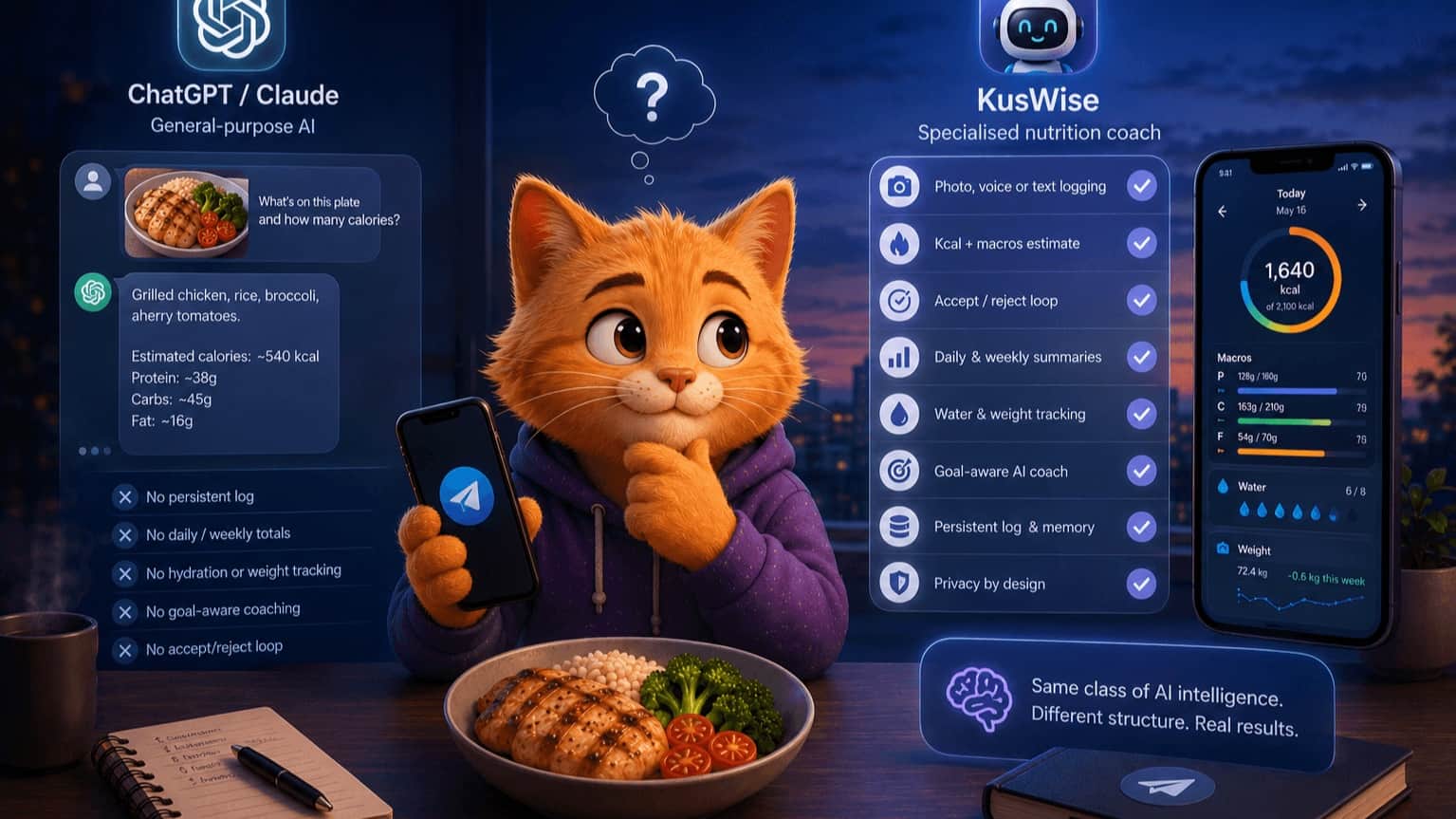
- No persistent log. Every new conversation on free tiers starts fresh. The model has no memory that you ate 410 kcal at breakfast — it can't tell you whether you're over goal at dinner.
- No structured daily / weekly totals. It returns prose. You'd have to copy each estimate into a spreadsheet to get a day sum, which defeats the purpose.
- No hydration, weight, streaks. It can answer "how much water should I drink" — but it can't keep a counter.
- No goal-aware coaching. It doesn't know your TDEE, your deficit, your protein target, or what you ate yesterday. Every answer is generic.
- No accept/reject loop. You read the estimate, then you have to do something with it — paste into a notes app, into MFP, into a spreadsheet. The friction sits exactly where it shouldn't.
A nutrition tracker has to do one thing very fast and very repeatedly. General AI does many things slowly and once.
Where KusWise's AI is specialised
KusWise uses the same class of model under the hood. The difference is what's wrapped around it:
- Trained on portion-from-photo specifically. The portion-estimation step is fine-tuned for plates of food, not general image understanding.
- Schema-locked outputs. The model returns { kcal, protein, carbs, fat, meal_slot } — not prose. That's what makes one-tap logging possible.
- Long-running user memory. Your log persists across days, weeks, months. The bot can answer "am I hitting protein this week" because it has the data.
- Plan-aware. The coach knows your goal (cut / maintain / build) and shifts its macro suggestions accordingly.
- Barcode scanning. Send the label of a packaged product and the bot returns the nutrition panel — no manual search.
- Restaurant menu calorie check. Snap the menu and get kcal estimates per dish before you order. No general-purpose chat does this in a usable form.
- Accept/reject loop. Every estimate is one tap away from being logged. Nothing is written silently.
Cost and access
ChatGPT Plus and Claude Pro cost around $20/month each, and even with them you'd be operating the spreadsheet yourself. KusWise has a free tier that covers logging, daily and weekly summaries, barcode + menu scanning, and the AI coach — using the same class of models inside the bot. You're not paying twice.
Privacy
Photos sent to ChatGPT or Claude can be used to improve their models (depending on tier and account settings). Photos sent to KusWise stay on Telegram's side and are never retained on our servers — we keep only the AI-generated text description of the meal, which is what we need to maintain your log. You can delete the original photo from your Telegram chat at any time. Different model wrapper, same calorie estimate, much smaller data footprint.
When raw ChatGPT or Claude is still the right tool
If you want to brainstorm a meal plan from scratch, learn the biochemistry of a macronutrient, write a custom workout, or debug code that processes your nutrition data — use ChatGPT or Claude. They're irreplaceable for open-ended thinking. If you want to log what you just ate, see your week, scan a menu, hit a protein target tomorrow — use a tool that's built for it. KusWise wraps the same intelligence in the structure that actually changes outcomes.
"ChatGPT can tell you what's on the plate. It can't tell you whether you're on track."