Tracking calories doesn't require an app. The data is the same whether it lives in a database or on a kitchen napkin. If you've burned out on apps — and many people do — three manual systems cover most of what an app gives you, with much less friction.
Method 1: hand portions
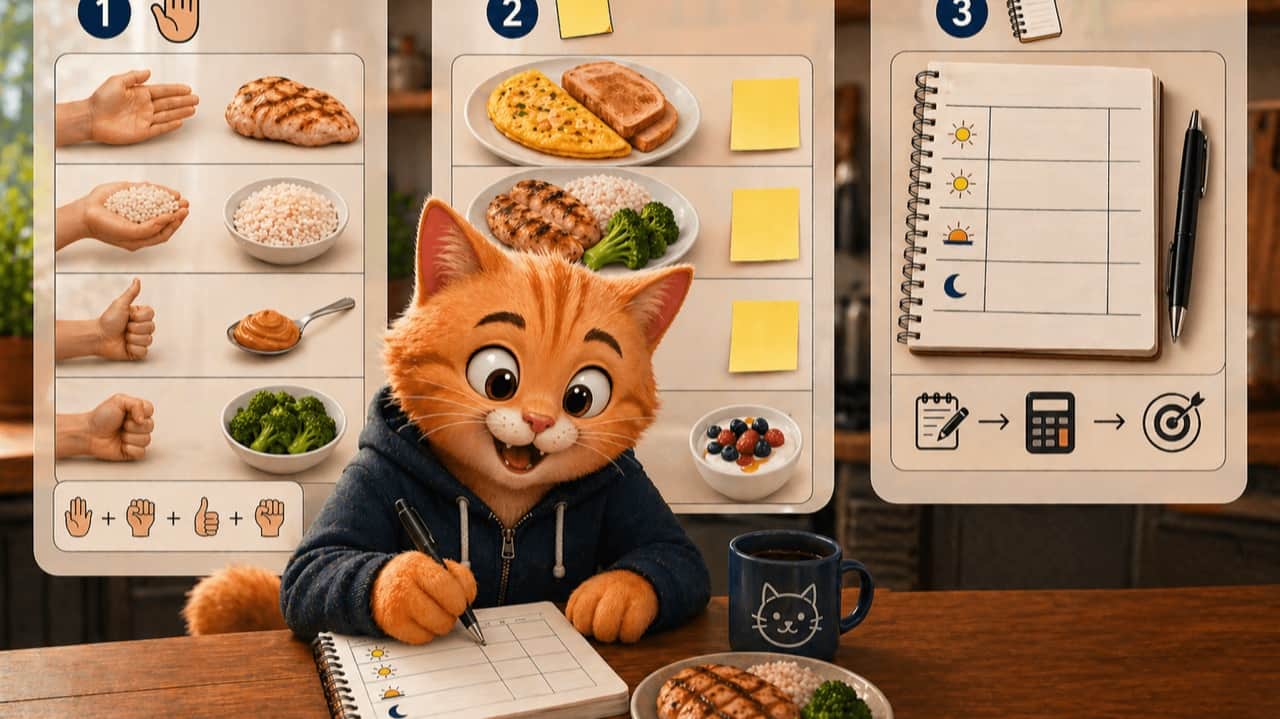
Skip the gram scale. Use your hand as the measurement tool, calibrated once.
- Palm of protein (cooked) ≈ 25–30 g protein, 150–200 kcal
- Cupped hand of carbs (cooked rice/oats/pasta) ≈ 35–45 g carbs, 150–180 kcal
- Thumb of fats (oil, butter, nut butter) ≈ 12 g fat, ~100 kcal
- Fist of vegetables ≈ negligible kcal, count it as a unit
Build each meal as 1 palm + 1 cup + 1 thumb + 1 fist. That's roughly 450–500 kcal with 25–30 g protein. Three meals like that lands ~1,400 kcal/day. Add or remove a thumb of fats and a cup of carbs to dial up or down.
Try KusWise on Telegram — log meals by photo, voice, or text in your existing chat. Free to start, no app to install.
Open in TelegramMethod 2: meal templates
Build 4–5 meals you eat often and weigh them once. Write the calories on a sticky note on the fridge. From then on, those meals are a known number; you stop thinking about them. Most people repeat the same 8–10 meals across a month — once those are quantified, you've solved 80% of your tracking.
Example: 3-egg omelette with cheese + 2 slices toast = 540 kcal / 30 g protein. Chicken breast (palm) + rice (cup) + olive oil (thumb) = 530 kcal / 35 g protein. Greek yogurt (200g) + berries + honey = 200 kcal / 18 g protein. Once known, never re-counted.
Method 3: pen-and-paper journal
An undated notebook. Each day a header, a list of meals, a rough calorie number next to each. End of week, sum the totals, compute the average, compare to your target. The act of writing each meal down is a 30-second pause that itself reduces overeating — there's a body of research on "food awareness" effects of journaling.
When manual breaks down
Three places. First, restaurant meals — you can't accurately hand-portion a curry that's been cooked in mystery quantities of oil. Second, multi-ingredient cooking from scratch — a stew or casserole becomes hard. Third, when accuracy matters more (precision cuts, contest prep, medical contexts).
For those cases, a photo-based AI logger handles what hand portions can't. You can run manual most of the week and use a bot for outliers.
"The best tracking method is the one you keep doing on day 60."
How KusWise handles this
If manual works for you, keep going — and use our free calculator to set your daily target. If you want a low-friction backup for restaurant nights and tricky meals, KusWise lives in Telegram (send /start). No app to install, no notifications. Use it for the meals you can't easily hand-portion, ignore it for the meals you can.